
How should we use customer reviews on our website, and what do the UK rules on fake reviews mean for us?
If you're a builder, roofer or kitchen fitter, your next customer has probably read your reviews before they pick up the phone. Here's a practical guide to putting genuine reviews where they help most on your website, asking happy customers for them fairly, and staying on the right side of the UK rules on fake and incentivised reviews that came into force in April 2025, with a checklist and a worked hypothetical example.
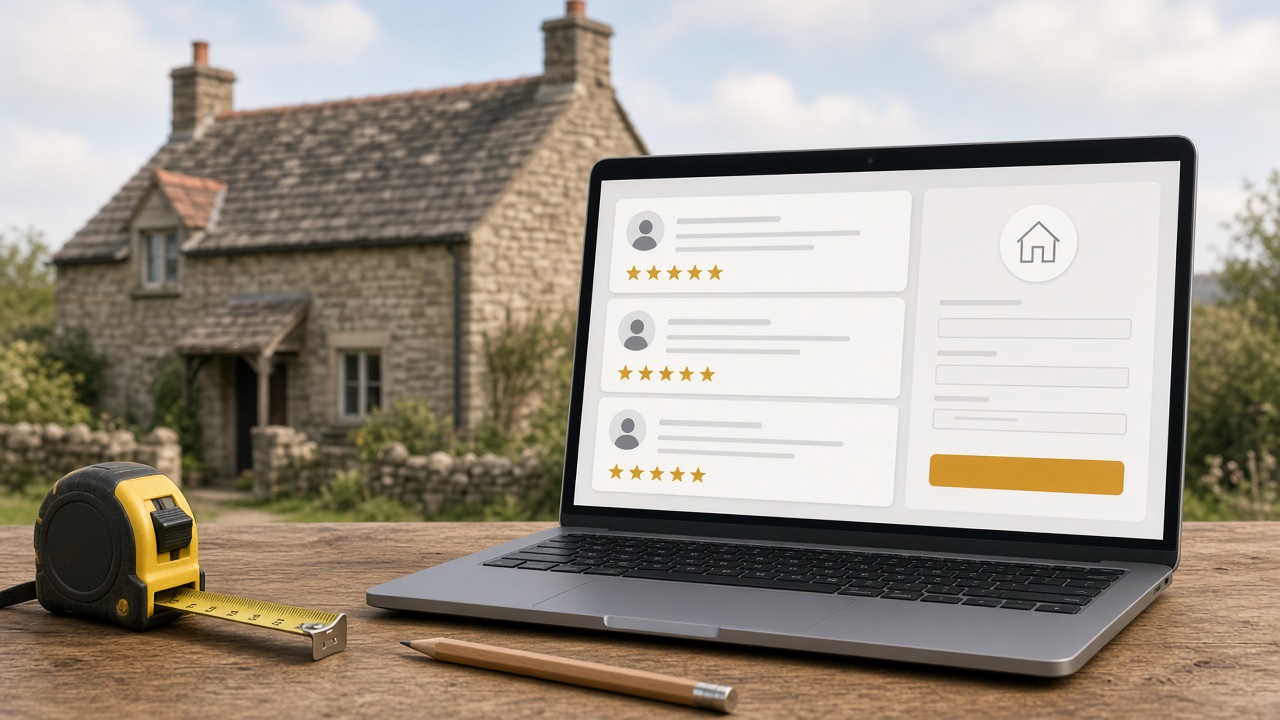
When homeowners in Somerset, Devon or Dorset choose a builder, roofer or kitchen fitter, many look up what other customers have said before they get in touch. Reviews are often doing quiet work long before the first phone call.
Many established firms have plenty of good feedback sitting on a Google profile or in a folder of thank-you messages, while the website itself says very little.
So the question is a practical one: how should you use customer reviews on your website so they actually help people decide to get in touch, and what do the newer UK rules on fake reviews mean for a business like yours? This article covers both, with a checklist at the end.
Why reviews matter more for trades than for most businesses
Building work is a big decision. The customer is letting someone into their home and living with the result for years, and they can't judge workmanship from a website.
That's why the most useful reviews for a trades business aren't the ones that say "Great service, five stars". They're the ones that answer the worries a new customer actually has: Did they turn up when they said they would? Did they keep the site tidy? Did the price change halfway through? What happened when something went wrong?
Where reviews help most on your website
A reviews page on its own is easy to miss. Reviews do more work at the moments someone is deciding.
Next to the enquiry point
The point where someone is about to fill in your contact form or ring you is where a little reassurance goes a long way. Two or three short, specific reviews beside the form can answer the last doubt before they press send. If you've recently looked at how your form itself works, our guide to how many questions your enquiry form should ask covers the other half of that moment.
On service pages
Someone reading your page about roof repairs wants to hear from people who had roof repairs, not from someone who was pleased with a garden wall. Matching reviews to services makes them far more relevant. If you have separate pages for each service or area, as covered in our guide to separate pages for services and areas, each one is a natural home for two or three matching reviews.
Choosing reviews that show specifics
Not every positive review is equally useful. When you're choosing which ones to show on your own pages, look for reviews that:
- mention the type of job (a loft conversion, a re-roof, a new kitchen)
- mention the area, where the customer is happy for that to be shown
- describe something concrete, such as how the team communicated, kept to time or dealt with a problem
- sound like a real person, in their own words
If you shorten a review, don't change its meaning or stitch two together.
Star ratings from an independent platform help too, but work best alongside specific comments rather than instead of them.
Getting permission and keeping reviews current
Permission
If a review was left publicly on a platform such as Google, it's still good practice to check the platform's terms before copying it onto your site, and to show it with the reviewer's first name or initials rather than their full name. For feedback that came to you privately, by email, text or a card, ask before you publish it. A simple message works: "Would you mind if we shared this on our website, with your first name and the village?"
Keep a note of who agreed and when.
Keeping them current
Reviews that all date from years ago can quietly suggest the business has slowed down. Add dates where you can, and refresh your selection a few times a year.
How to ask happy customers for reviews fairly
Ask shortly after the job is finished, while the details are fresh. A few principles keep it fair:
- Ask everyone, not just the ones you're sure will be glowing. Picking only the happiest customers to invite can skew the picture.
- Make it easy. Send a direct link to where you'd like the review left, rather than asking people to search for you.
- Don't write it for them. You can suggest what might be useful ("it helps other homeowners if you mention the type of job"), but the words should be theirs.
- Be careful with rewards. Offering money, discounts or gifts in exchange for reviews brings the incentivised-review rules into play, and many review platforms have their own restrictions. The simplest approach for most trades is not to offer anything.
- Don't ask staff, friends or family to post reviews presenting themselves as customers.
What the UK rules on fake reviews now mean
This section is a plain-English summary for general information. It is not legal advice. If you're unsure how the rules apply to your business, check the guidance linked below or take advice.
The Digital Markets, Competition and Consumers Act 2024 introduced a list of commercial practices that are banned outright. The review-related part is paragraph 13 of Schedule 20 to the Act, which came into force on 6 April 2025 under The Digital Markets, Competition and Consumers Act 2024 (Commencement No. 2) Regulations 2025.
In summary, it bans:
- submitting, or commissioning someone to submit or write, a fake consumer review, meaning one that claims to be based on a genuine experience but isn't
- submitting or commissioning a review that hides the fact it was incentivised
- publishing consumer reviews, or information drawn from them, in a misleading way. The Act's own examples include hiding negative reviews while publishing positive ones, giving positive reviews greater prominence than negative ones, and leaving out relevant information such as the fact that a reviewer was paid
- publishing consumer reviews without taking reasonable and proportionate steps to prevent, and remove, fake reviews, concealed incentivised reviews and false or misleading review information
The Competition and Markets Authority (CMA) has published guidance on fake reviews and a short guide for businesses publishing consumer reviews. The short guide says traders who publish reviews should have a published policy that clearly prohibits fake reviews and sets out their approach to incentivised reviews, and should assess the risk of banned content appearing in content they control. It's also clear that what counts as reasonable depends on the circumstances of each business.
What that means in practice for a typical trades firm
For a local builder showing a handful of genuine customer reviews, the message is straightforward: don't invent reviews, don't pay for them without making that clear, don't present a curated selection as the full picture, and have a proportionate way of making sure what you publish is genuine. A few habits help:
- Keep a record of where each review on your site came from.
- If you show a selection, say so, for example "A few recent comments from customers", and link to your full, independent review profile so people can see everything.
- Add a short note to your website, perhaps on your reviews page, confirming that you only publish genuine reviews from real customers and don't pay for reviews.
- Read the CMA's short guide once and decide what's proportionate for your size.
If your website lets anyone post reviews directly, expect more to think about; the full CMA guidance is the place to start.
A worked example (hypothetical)
This is a hypothetical example for illustration. It is not a real business or a real result.
Imagine a family-run roofing firm near Taunton with many positive Google reviews, but a website "Testimonials" page of six undated quotes, two mentioning someone who left years ago.
Rather than buying a review widget, they:
- Pick nine recent Google reviews that mention a specific type of job: three about re-roofs, three about repairs and three about flat roofs.
- Add three matching reviews to each of the three service pages, with the reviewer's first name, town and month.
- Put the three most reassuring ones, about turning up on time and explaining the work clearly, beside the contact form.
- Add a line under each group: "A selection of recent reviews. See all our reviews on Google", with a link.
- Add a short statement to the testimonials page saying they only publish genuine reviews from real customers and don't offer rewards for reviews.
- Set a reminder to refresh the selection every three months and to send every finished job a review link.
None of this needs a rebuild.
When a smaller step is enough
You don't necessarily need a review widget or a new website. For many trades firms, a smaller step is enough:
- Add three good, specific reviews next to your contact form, with a link to your full Google or trade-platform profile.
- Remove or update anything clearly out of date, such as reviews naming former staff.
- Add a one-line honesty statement about genuine reviews.
A live review feed or connected system makes more sense if you get a steady stream of new reviews or want review requests sent automatically after each job. Otherwise, careful manual selection is often the better option.
Checklist: using reviews on your website
- Reviews appear beside the main enquiry point, not only on a separate page
- Each service page shows two or three reviews about that service
- Reviews chosen mention specifics, not just star ratings
- You have permission for any review that came to you privately
- A curated selection is labelled as such, with a link to your full review profile
- You ask every customer for a review, not just the happiest ones
- You don't write, buy or pay for reviews without making that clear
- Your site includes a short statement that you only publish genuine reviews
- You've read the CMA's short guide and decided what's proportionate for you
- There's a reminder to refresh the selection every few months
Your next step
Westward Digital builds websites and connected lead systems for established businesses across Somerset, Devon, Dorset, Bristol and Bath & North East Somerset. Marcus plans the work directly, and projects start from £4,500. If you'd like help deciding where reviews would do the most good on your site, and whether a small change is enough, get in touch for a no-pressure conversation.
Working through something similar?
We can help you work out what to address first.